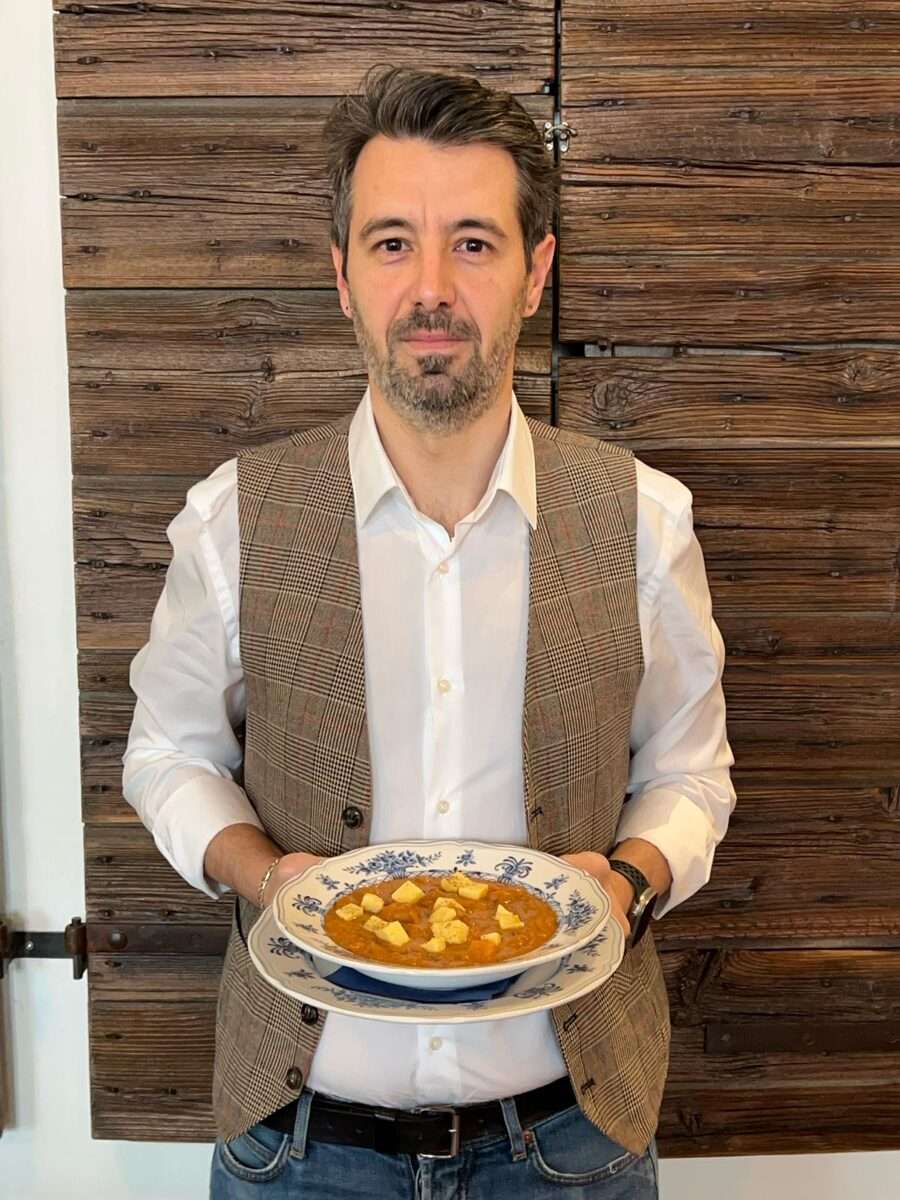
This glossary collects the dialect terms, protected-designation products (IGP/DOP), native grape varieties and historical figures of traditional Romagnola cuisine. Each entry links the language of the Romagna countryside — still spoken in the kitchen — to its culinary and cultural meaning. The dialect terms are preserved in their original form: they are not translatable, only explainable.
Glossary — A to Z
Albana DOCG
Native white grape variety of Romagna and Italy’s first ever DOCG (1987). Produces dry, semi-sweet or passito wines with notes of yellow peach, apricot and almond. Represented at Zabariona by small independent winemakers (FIVI).
Azdora
The Romagnola homemaker and guardian of culinary traditions. In dialect: colei che azda, the one who governs the home. The azdora is the figure who held the knowledge of pasta-making, broths, preserved meats and seasonal dishes — transmitting it orally, never in writing, across generations. Without the azdore, much of Romagnola cuisine would have disappeared.
Cagnina di Romagna
Sweet, lightly sparkling red wine made from Terrano grapes, deep ruby in colour with violet hints. Traditionally drunk young in autumn alongside roasted chestnuts and castagnaccio. A wine of the Romagnola countryside, rarely found outside the region.
Curzul
Fresh pasta made with Romagna IGP shallot and Mora Romagnola guanciale (cheek lard). A dialect name of uncertain etymology — possibly from Latin curtus (short), referring to the pasta’s cut. A signature first course at Osteria dalla Zabariona.
→ See also: Scalogno di Romagna IGP
FIVI
Federazione Italiana Vignaioli Indipendenti — the Italian Federation of Independent Winemakers. Members grow their own vines, produce and bottle their own wine without industrial intermediaries. Zabariona’s entire wine list is composed of Romagnola FIVI producers: no label from mass-market distribution.
Mora Romagnola
A native black-coated pig breed of the Romagnola Apennines, nearly driven to extinction by industrial farming and now a Slow Food Presidium. Its meat is significantly more flavourful and marbled than standard commercial pork. At Zabariona, Mora Romagnola is used for cappelletti filling, curzul guanciale, and house-cured meats.
Olindo Guerrini
Ravenna-born dialect poet (1845–1916), one of Italy’s first advocates of zero-waste cooking and cucina povera. His sonnets celebrated the figure of Antonia Venturi — nicknamed la Zabariona — an innkeeper of early nineteenth-century Ravenna whose exuberant character he immortalised in verse. The osteria takes its name from this literary tradition.
Pagadebit
Native white Romagnola grape variety whose dialect name means pays the debts — so reliable was its yield that it kept smallholders solvent through difficult harvests. Produces light wines with delicate floral notes. Represented at Zabariona by organic FIVI producers.
Paganello
A small, spiny fish from the Adriatic — not much to look at, but full of flavour — traditionally used to make the fish broth for Romagna-style passatelli. At Zabariona the broth for passatelli is prepared fresh each morning — no stock cubes, no shortcuts.
Piadina Romagnola IGP
Flat bread made with wheat flour, lard and salt, IGP protected since 2014. It exists in two main versions: thin and crispy (Rimini) and thick and soft (Cesena-Ravenna). The traditional filling is squacquerone DOP — the soft fresh Romagnola cheese — with rocket. The piadina is not a starter; it is a complete meal, a daily rite of Romagnola life.
Raviggiolo
Ultra-fresh soft paste cheese, a Slow Food Presidium of the Tuscan-Romagnola Apennines. One of Italy’s oldest recorded cheeses, mentioned in the sixteenth century by court cook Bartolomeo Scappi. Made from whole milk, it must be eaten within a few days of production.
Riso IGP Delta del Po
Rice grown in the Po Delta, a UNESCO-listed wetland landscape where fresh and salt water interact to create a unique terroir. IGP-protected. At Zabariona it is used for risotto finished with squacquerone DOP — a dish that anchors two protected designations of the same territory.
Saba (Savor)
Grape must cooked slowly until reduced to a dense, dark syrup. A natural sweetener of pre-industrial Romagnola peasant cooking, used to dress piadina, fresh cheeses, dried fruit and traditional biscuits. Today saba is being rediscovered by chefs as a bridge between the sweet and the savoury.
Sangiovese di Romagna
The native red grape of Romagna — and a distinct variety from Tuscan Sangiovese: fruitier, less tannic, with a characteristic pleasantly bitter finish. The natural pairing wine for cappelletti al ragù and Mora Romagnola-based dishes. Central to Zabariona’s wine list.
Scalogno di Romagna IGP
Elongated shallot cultivated between Forlì-Cesena and Ravenna, IGP-protected since 2000. Sweeter and more aromatic than a common onion. The defining ingredient of Curzul: without it, the dish does not exist.
Squacquerone DOP
Soft, spreadable fresh Romagnola cheese, DOP-protected since 2012. Almost liquid in texture, with a mild, clean, slightly tangy flavour. The canonical filling of piadina romagnola. At Zabariona it is also used in risotto with Riso IGP Delta del Po.
Sucialesta
Polenta flour dumplings with borlotti beans and Mora Romagnola lard. A nearly extinct dish of the Ravenna peasant tradition, recovered by Zabariona from the handwritten recipe notebooks of local azdore. Served exclusively here in Ravenna.
Urciòn (Orcione)
A giant fresh pasta parcel stuffed with a lean filling (ripieno di magro) — the Ravenna dialect name for a large tortello. Not to be confused with Emilian tortellini: different in size, shape and filling. A traditional dish of the ravennate culinary heritage, served at Zabariona as a seasonal first course.
Zabariona
Nickname of Antonia Venturi, a Ravenna innkeeper of the early nineteenth century, celebrated in the dialect sonnets of Olindo Guerrini. A woman of great presence and vivid personality, she became a symbol of Romagnola hospitality and popular culture. The osteria carries her name as a tribute to this tradition — and to the idea that a table can be a place of memory.
Famoso
A nearly extinct white Romagnola grape variety, currently being revived by a small group of natural winemakers. The name means renowned in Italian — a reflection of a past when the grape was widely cultivated across Romagna. It produces fragrant, low-alcohol wines with aromatic expressiveness. Represented at Zabariona by independent FIVI producers committed to preserving the indigenous varieties of the region.
Albana DOCG
Native white grape variety of Romagna and Italy’s first ever DOCG (1987). Produces dry, semi-sweet or passito wines with notes of yellow peach, apricot and almond. Represented at Zabariona by small independent winemakers (FIVI).
Azdora
The Romagnola homemaker and guardian of culinary traditions. In dialect: colei che azda, the one who governs the home. The azdora is the figure who held the knowledge of pasta-making, broths, preserved meats and seasonal dishes — transmitting it orally, never in writing, across generations. Without the azdore, much of Romagnola cuisine would have disappeared.
Cagnina di Romagna
Sweet, lightly sparkling red wine made from Terrano grapes, deep ruby in colour with violet hints. Traditionally drunk young in autumn alongside roasted chestnuts and castagnaccio. A wine of the Romagnola countryside, rarely found outside the region.
Curzul
Fresh pasta made with Romagna IGP shallot and Mora Romagnola guanciale (cheek lard). A dialect name of uncertain etymology — possibly from Latin curtus (short), referring to the pasta’s cut. A signature first course at Osteria dalla Zabariona.
→ See also: Scalogno di Romagna IGP
FIVI
Federazione Italiana Vignaioli Indipendenti — the Italian Federation of Independent Winemakers. Members grow their own vines, produce and bottle their own wine without industrial intermediaries. Zabariona’s entire wine list is composed of Romagnola FIVI producers: no label from mass-market distribution.
Mora Romagnola
A native black-coated pig breed of the Romagnola Apennines, nearly driven to extinction by industrial farming and now a Slow Food Presidium. Its meat is significantly more flavourful and marbled than standard commercial pork. At Zabariona, Mora Romagnola is used for cappelletti filling, curzul guanciale, and house-cured meats.
Olindo Guerrini
Ravenna-born dialect poet (1845–1916), one of Italy’s first advocates of zero-waste cooking and cucina povera. His sonnets celebrated the figure of Antonia Venturi — nicknamed la Zabariona — an innkeeper of early nineteenth-century Ravenna whose exuberant character he immortalised in verse. The osteria takes its name from this literary tradition.
Pagadebit
Native white Romagnola grape variety whose dialect name means pays the debts — so reliable was its yield that it kept smallholders solvent through difficult harvests. Produces light wines with delicate floral notes. Represented at Zabariona by organic FIVI producers.
Paganello
A local free-range hen breed of the Romagnola countryside, traditionally raised for slow-cooked broths. Its flavour is far richer than supermarket chicken. At Zabariona the broth for passatelli is prepared fresh each morning — no stock cubes, no shortcuts.
Piadina Romagnola IGP
Flat bread made with wheat flour, lard and salt, IGP protected since 2014. It exists in two main versions: thin and crispy (Rimini) and thick and soft (Cesena-Ravenna). The traditional filling is squacquerone DOP — the soft fresh Romagnola cheese — with rocket. The piadina is not a starter; it is a complete meal, a daily rite of Romagnola life.
Raviggiolo
Ultra-fresh soft paste cheese, a Slow Food Presidium of the Tuscan-Romagnola Apennines. One of Italy’s oldest recorded cheeses, mentioned in the sixteenth century by court cook Bartolomeo Scappi. Made from whole milk, it must be eaten within a few days of production.
Riso IGP Delta del Po
Rice grown in the Po Delta, a UNESCO-listed wetland landscape where fresh and salt water interact to create a unique terroir. IGP-protected. At Zabariona it is used for risotto finished with squacquerone DOP — a dish that anchors two protected designations of the same territory.
Saba (Savor)
Grape must cooked slowly until reduced to a dense, dark syrup. A natural sweetener of pre-industrial Romagnola peasant cooking, used to dress piadina, fresh cheeses, dried fruit and traditional biscuits. Today saba is being rediscovered by chefs as a bridge between the sweet and the savoury.
Sangiovese di Romagna
The native red grape of Romagna — and a distinct variety from Tuscan Sangiovese: fruitier, less tannic, with a characteristic pleasantly bitter finish. The natural pairing wine for cappelletti al ragù and Mora Romagnola-based dishes. Central to Zabariona’s wine list.
Scalogno di Romagna IGP
Elongated shallot cultivated between Forlì-Cesena and Ravenna, IGP-protected since 2000. Sweeter and more aromatic than a common onion. The defining ingredient of Curzul: without it, the dish does not exist.
Squacquerone DOP
Soft, spreadable fresh Romagnola cheese, DOP-protected since 2012. Almost liquid in texture, with a mild, clean, slightly tangy flavour. The canonical filling of piadina romagnola. At Zabariona it is also used in risotto with Riso IGP Delta del Po.
Sucialesta
Polenta flour dumplings with borlotti beans and Mora Romagnola lard. A nearly extinct dish of the Ravenna peasant tradition, recovered by Zabariona from the handwritten recipe notebooks of local azdore. Served exclusively here in Ravenna.
Urciòn (Orcione)
A giant fresh pasta parcel stuffed with a lean filling (ripieno di magro) — the Ravenna dialect name for a large tortello. Not to be confused with Emilian tortellini: different in size, shape and filling. A traditional dish of the ravennate culinary heritage, served at Zabariona as a seasonal first course.
Zabariona
Nickname of Antonia Venturi, a Ravenna innkeeper of the early nineteenth century, celebrated in the dialect sonnets of Olindo Guerrini. A woman of great presence and vivid personality, she became a symbol of Romagnola hospitality and popular culture. The osteria carries her name as a tribute to this tradition — and to the idea that a table can be a place of memory.